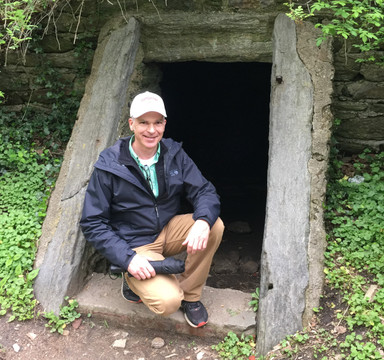
At the invitation of William Penn, Johannes Kelpius, a college-educated European mystic brought a group of like-minded led Separatists to the Wissahickon Creek near Philadelphia in 1694. Once here, they awaited the Second Coming of Christ and the New Millennium. Not an idle group by any means, they built a meetinghouse and an astronomical observatory, grew crops and a medicinal garden, and freely interacted with their neighbors, offering both spiritual and medicinal aid, and writing both poetry and music.
My son Neal and I visited the supposed site of their mediation cave in the Wissahickon Valley Park this past spring.

Conrad Beissel, founder of the Ephrata Commune, came to America in 1720 hoping to find Kelpius, but he was too twelve years too late. He did share many of Kelpius’ beliefs, which had their origins with German mystic and theologian Jakob Böhme.
Heinrich Bernhard Koster was a member of Kelpius’ original Wissahickon Society, also called The Society of the Woman in the Wilderness. When the New Millennium failed to materialize in 1694, Koster started to drift away. He became affiliated with the followers of George Keith, who in 1691 had begun disrupting the Philadelphia area Quaker world by trying to lead them back a more orthodox form of Christianity, while Kelpius and the others maintained a strong relationship with the Quakers.
Evidently Koster, Thomas Rutter*, William Davis, and Thomas Bowyer teamed up and published a pamphlet of their radical views (in High German and in English) entitled “Advice for All Professors and Writers.” No copies have been found, but in 1697 Francis Daniel Pastorius, founder of Germantown, published a refutation of this pamphlet entitled “Henry Bernhard Koster, William Davis, Thomas Rutter & Thomas Bowyer, four boasting disputers of this world briefly rebuked, and answered according to their folly, which they themselves have manifested in a late pamphlet, entitled, Advise for all professors and writers.” This pamphlet does exist and it gives insight into the contents of the former publication and the activities of the four named men. It hints at a communal experiment called “Irenia” near Germantown.
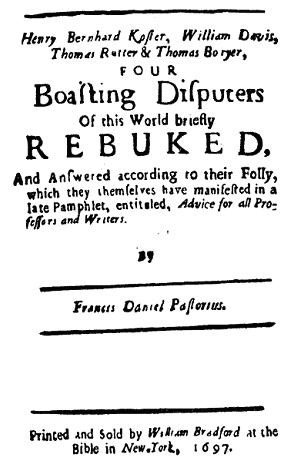
To quote Pastorius:
“They stile themselves The Brethren in America, The True Church of Philadelphia or Brotherly Love, &c. This sounds mightily afar off, and some silly Women in Germany, who may happen to see their pamphlet, which probably for that end and purpose was printed in the high Dutch tongue besides the English will be ready to think this Church or Brotherhood something real and considerable. But to undeceive those, who prefer Truth before fictions and falsehood, I herewith must inform them that all these specious Names and Epithets in the pages above quoted, and more others, are mere Kosterian Chimera, an idle fancy. He, the said H. B. Koster, arriving here in Pensilvania, his heart and head filled with Whimsical and boisterous Imaginations, but his hands and Purse emptied of the money, which our Friends beyond Sea imparted unto him, and some in his Company, was so cunning as to entice four or five to a Commonalty of Goods, and so settled a Plantation near German-town, upon a tract of Land given unto them, calling the same IRENIA; that is to say, the house of Peace, which not long after became ERINNIA, the House of raging Contention, and now returned to the donor, the Brethren of America being gone and dispersed, and the Church of Philadelphia (falsely so-called) proving momentary, and of no moment.” Since Pastorius says “falsely so-called,” I assume he means there was no official connection to Jane Leade’s London group “The Philadelphian Society For The Advancement Of Piety And Divine Philosophy.”
In a manuscript of the Pennepek (Pennypack) Baptist Church, it is written that “Wm. Davis, with one Henry Bernard Koster, a German, and others made up a kinde of Society, did break bread, lay on hands, washed one another’s feet, and went about having a community of goods. But in little time they disagreed & broke to pieces.”
In 1743, Rev. Ernst Ludwig Rathlef published a German biographical sketch of Koster, based on an interview he had had with the subject in 1730. Rathlef states that after Koster helped to build the Wissahickon community “[He] together with two others, bought another tract at Plymouth, not far from Germantown, where he remained for a length of time.”
The Pastorius and Rathlef accounts differ as to how the land for Irenia was acquired, but as Pastorius’ was contemporary to the events, I’ll hazard a guess that the land was donated and later reverted to the original owner. The dates are a bit confused, but the following material from the Philadelphia County Commissioners records indicate that there are land documents referring to “Irenia Land” circa 1695 (I need to track down these records):
“At a Session of the Commissioners at Philadelphia the 23d of the 12th Mo’th, 1701. Present, Edward Shippen, Griffith Owen, Thomas Story, James Logan, Sec’ry… The Commiss’rs, by Patent dated 26th 9 mo., 1695 [sic], Granted 500 acres to Rob’t Longshore, Purchaser in Bristol Township, in the County of Philad’a, joyning on Germantown, Irenia Land, and Will’m Wilkins, of which by Deed dated 1st 4 mo., 1686, he sold to Samuel Bennet 200 acres, who by Deed dated 2, 4, 1695, sold 150 thereof to David Potts, who sold to Wm. Harman 50 acres now in the Possession of Peter Clever.”
Based on the above, together with the 1687 Holmes Map of Philadelphia area landowners, I believe that Irenia was not in Plymouth Township, which did not border Germantown, but rather in Bristol Township, on land donated by the Bowyer family, adjacent to land of Thomas Rutter and Samuel Bennett (which they had purchased from Robert Longshore). Thomas Bowyer seems to have played a rather minor role, as his three fellow communitarians figure in many later events, but his name disappears from history.
*Thomas Rutter, who arrived in the colony as a Quaker, established Pennsylvania’s first iron forge, on the Manatawny Creek, in 1716, and later joined the Seventh Day Baptist Church.
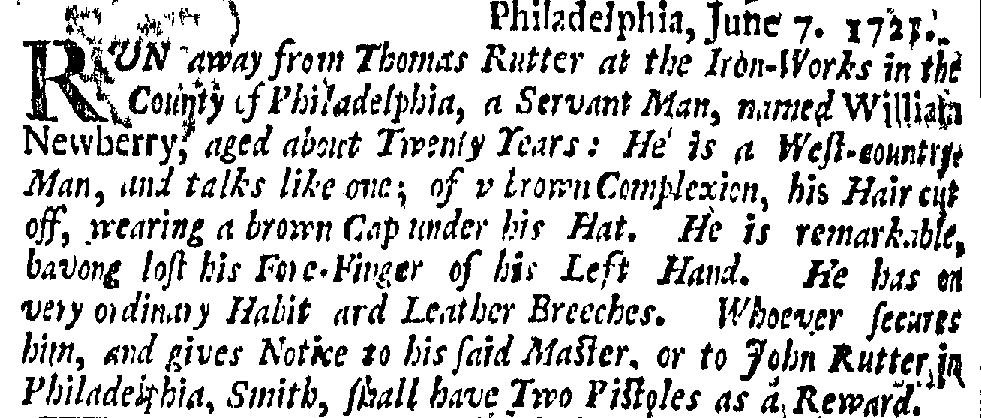
American Weekly Mercury, Philadelphia, June 1, 1721