In honor of the upcoming Fourth of July holiday, this blog includes the complete chapter on Aaron Jedel, Newark, Delaware manufacturer of sparklers under the names “A. Jedel Company” and “International Pyrotoy”, taken from my eBook Sparkler Mania: The Early History of America’s Favorite Hand-Held Fourth of July Fireworks. My friends in Elkton, Maryland may be interested to know that it was Jedel who brought chemist Josef “Ben” Decker over from Germany in 1914 to work in his sparkler factory. Decker left in 1919 to start the Victory Sparkler Company in Elkton, which eventually evolved into the Triumph Explosives Company, a munitions manufacturing plant during World War II. The site of the Triumph works was later taken over by the Thiokol Chemical Corporation to manufacture solid rocket motors for the US military, and that company, as you know, is now a very important part of the Orbital ATK corporation. The fascinating story of Decker, Victory, and Triumph can also be found in my eBook.
Aaron Jedel’s story follows a very familiar pattern amongst the sons of mid-19th century Jewish immigrants to America. His father took advantage of a well-established mercantile tradition and set the stage for Aaron to become a successful American businessman.
Aaron’s father, Joseph Jedel, was born in France about 1833, and his wife Caroline was born in Wurtemberg about 1836. They were of Jewish heritage. Joseph immigrated to the United States, arriving on August 8th, 1853, at the age of 20 aboard the ship “Old England” which last departed from Liverpool, England. The 1860 and 1870 US censuses for Newark, New Jersey (Ward 13 in 1860 and Ward 6 in 1870), indicate that Joseph was a peddler of Yankee Notions.
Joseph and Caroline’s first child, Mary, was born in January of 1860, according to the 1860 census. Also in the household at that time were 3 other French-born peddlers: Solomon Jedel (24), Solomon Levi (18), and Solomon Martz (14).
“Peddlers were the foot soldiers of [an American marketing revolution in the early 19th century]. They were the proverbial middlemen who purchased goods (usually on credit) from producers and set forth to transport and market them to far-flung consumers…Peddling was a difficult and tiring occupation, but it required very little capital and promised substantial returns.
As the desire for goods rose … young, vigorous, success-minded immigrants rushed in to meet the burgeoning demand. Many of these immigrants--indeed, most of the 16,000 peddlers listed by the 1860 census-taker, according to one source--were Jews.
... For immigrants to America in the 19th century… peddling was less a career than a starting point; it served as the standard business apprenticeship for able-bodied young male Jews…looking to ascend the economic ladder to success.
Coming to America in their late teens or early 20s, these young men spent one to five years selling notions, dry goods, secondhand clothing, cheap jewelry, and similar products as they learned English and accumulated capital. Then they moved on to something better. Some succeeded handsomely: Most of the great Jewish department store
magnates began their lives as peddlers, and so did a large number of other Jewish businessmen.”
“Peddlers Peddling, Judaism Spreading: How the market revolution helped bring Judaism to the American frontier”, by Jonathan Sarna, from American Judaism: A History, Yale University Press, 2004.
In the 1900 US Census for Newark, NJ, Aaron Jedel is listed as a “Wooden Ware Dealer”.
In October of 1907 Jedel was importing matches from Austria for sale in the U.S.
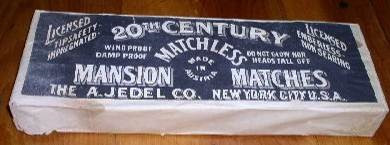
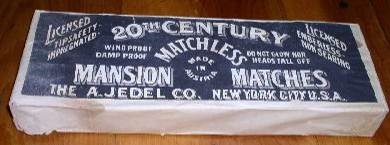
“A. Jedel Co.’s Twentieth Century Match. The A. Jedel Company, Newark, N.J., is marketing the ‘Twentieth Century’ brand of Matches, and some weeks’ use of them demonstrates that they are exceptionally reliable. On the box these claims are made for them: ‘Impregnated; dampproof; tip safety; emberless; non-glowing.’”
Wooden and Willow Ware Trade Review, October 10, 1907
November 20, 1907, Aaron Jedel applied for a U.S. Patent on a pyrotechnical toy (see chronological section). This is the first US sparkler patent awarded to an American. It is likely that he contracted with Wilhelm Weiffenbach, the German manufacture to produce his invention, for as early as January, 1908 he was importing fireworks from Stuttgart (the residence of Weiffenbach, as noted in his 1895 British sparkler patent),
“DEFENDANT WANTS JUDGMENT OPENED. Legal Fight in Fireworks Case in Which Some $350 Are Involved.
Fireworks alleged to be defective and which were shipped back to the firm which sold them formed the grounds for an argument before Justice Hubbs this morning to open a $350 default judgment.
Arthur R. Ferris of Utica bought the fireworks from Aaron Jedel of New York, ordering $1,000 worth in January, 1908. Mr. Ferris claimed he had a bad year and tried to induce the New Yorker to take some of them back, but he refused, relying on his contract with a clause preventing cancellation of part of the order.
Mr. Jedel did not manufacture the fireworks himself but was only the jobber so when they arrived in New York he notified Mr. Ferris, who sent a check of $300.
Mr. Ferris says he had complaints from his customers that the fireworks were defective and he shipped them back to New York and sued Mr. Jedel, obtaining his judgment.
Mr. Jedel asked to have the judgment opened to fight the case with Mr. Ferris objecting on the grounds that a year has passed since the judgment was obtained. Mr. Jedel claimed that Mr. Ferris had then been willing to have the judgment reopened for $100 several months ago.
A commission was sent to Stuttgart, Germany, to examine the manufacturers but the head of the company refused to testify and the German law had no way of forcing him to do so. No report was ever received on this commission. Leo and Dowling appeared for Mr. Ferris and Justice Hubbs took the papers after hearing the arguments.”
Syracuse Journal, August 17, 1912
In the 1909 article below he was noted as working with German sparkler manufacturer Wilhelm Weiffenbach, and we saw earlier that Wilhelm Weiffenbach had a factory in that city. This was either a contract deal or perhaps a partnership.
“PHILADELPHIA, January 5, 1909. –The fireworks firms are beginning to take large orders for the Fourth of July trade. Among those recently here were William Turner, of the Un-X-Ld Company; C.A. Rodgers, of the Pain Manufacturing Company; Lew Willey, of the Nordlinger-Charlton Fireworks Company; Mr. Seibert, of George F. King, and Mr. Jedel, of The A. Jedel Company, representing William Weiffenbach, the German manufacturer.”
The American Stationer, January 9, 1909
The following article proclaims that Jedel had a plant in Stuttgart and a branch factory in Newark, NJ, which should have read Newark, Delaware, as we shall soon see.
“Charlotte Firm Loses, A. Jedell Company of Newark Gets Verdict for $375.
The A. Jedell Company of Newark, N.J. won its suit for $375 against the Charlotte Hardware Company in superior court yesterday. In March, 1910, the Charlotte concern placed an order for $600 worth of sparklers and other fireworks. The Jedell main plant is in Stuttgart, Germany, with a branch factory in Newark, and an office in New York at which imports are received. Some time after filing the order the Charlotteans decided to cancel part of it, and so notified the Jedell company. The latter’s representative replied that it would hold the hardware company responsible to the extent of $375 on the original contract. This, the local people refused to agree to. Clarkson & Duis appeared for the plaintiff in the trial yesterday, which occupied much of the day. Hugh W. Harris represented the defendant. The jury returned a verdict for the plaintiff.”
Charlotte [North Carolina] Observer, May 1, 1912
Trow’s Co-Partnership and Corporation Directory for the City of New York for 1908 associates Aaron Jedel with both the A. Jedel Co. and the United Pyrotechnische Fabrikanten, with an address of 17 Battery Place for both. The second firm likely represents the business relationship between Jedel and Weiffenbach.
Late in 1909 Jedel incorporated the International Pyrotoy Company.
“The International Pyrotoy Company, New York, was recently incorporated to manufacture fireworks and explosives; capital, $1,000 / The incorporators are Aaron Jedel, M. Jedel, both of 524 West 123rd street; Josephine M. Moesch, 134 West 139th street, all of New York.”
“Trade Items,” The American Stationer, October 9, 1909
According to the 1910 US Census for Manhattan, Ms. Moesch was a secretary.
The following year Jedel was manufacturing his own sparklers in Newark, Delaware, in the former Helio Match Company factory. Like many fireworks factories, his suffered a disaster soon thereafter.
“Fireworks Plant at Newark [Delaware]. The match factory building near the P.B. & W. R.R. station at Newark, long unused, has been sold to the A. Jedel Company, of New York, who will make additions and establish a fireworks factory, employing possibly, one hundred hands.”
Cecil Whig, Elkton, Maryland, Saturday, Feb. 5, 1910
“Fire Works Factory Burned. The long brick structure, near the P.B. & W. R.R. station at Newark, Del., formerly the Helio Match Factory, for some months past used by A. Jedel & Co. of New York, manufacturers of fireworks novelties, was burned on Wednesday morning. The blaze started about 7 o’clock, just as the hands were going to work, and was caused by spontaneous combustion of chemicals, and there were numerous explosions during the fire’s progress. Firemen and other residents of Newark hurried to the scene, but lack of water prevented fighting of the flames, and the building was destroyed within half an hour. It was 40 x 200 feet, one story in height. The loss is put at $10,000, with partial insurance. The plant employed about 30 hands and was prospering.
Cecil Whig, Elkton, Maryland, Saturday, May 14, 1910
It appears that Aaron’s brother Herman was also in the fireworks business, probably as an importer, although the records of this are rather scarce. I did find in the 1911 City Directory for New York City that Aaron was listed in the novelties business and Herman in fireworks (in the 1907-1910 Newark, New Jersey Directories, the A. Jedel Company was selling “grocers’ sundries”).
“Appeal from Municipal Court, Borough of Manhattan, First District.
Action by Alfred Czerweny against the National Fire Insurance Company of Hartford. From judgment for plaintiff, defendant appeals. Affirmed by the opinion below.
The following is the opinion of Judge Spiegelberg, in the trial court:
This action, which was submitted upon an agreed statement of facts, is brought by the plaintiff , as assignee of Herman Jedel, to recover upon a policy of insurance issued by the defendant to A. Jedel Company. Some time prior to March 9, 1910, Herman Jedel, who was doing business under the name of the Anglo-American Fireworks Company, was the owner of a quantity of matches which were deposited by him in a brick warehouse owned by A. Jedel Company at Newark, Del., under an arrangement with said company. ..
The clause relating to the insurance of the stock reads as follows: “On stock, materials and supplies made up and in process, their own or held in trust, on consignment, or sold but not removed, while contained in brick buildings situate near Pennsylvania Railroad station, Newark, Delaware.”
…On May 11, 1910, the building in question, together with others and their contents, were destroyed by fire, and among the goods destroyed were the matches owned by Herman Jedel…”
The New York Supplement: Supreme and Lower Courts of Record of New York State, West Publishing Co., St. Paul, MN, Febrary 3 – March 10, 1913
Aaron Jedel was also coming up with other novelties for the wholesale trade at this time, including a trick cigarette case.
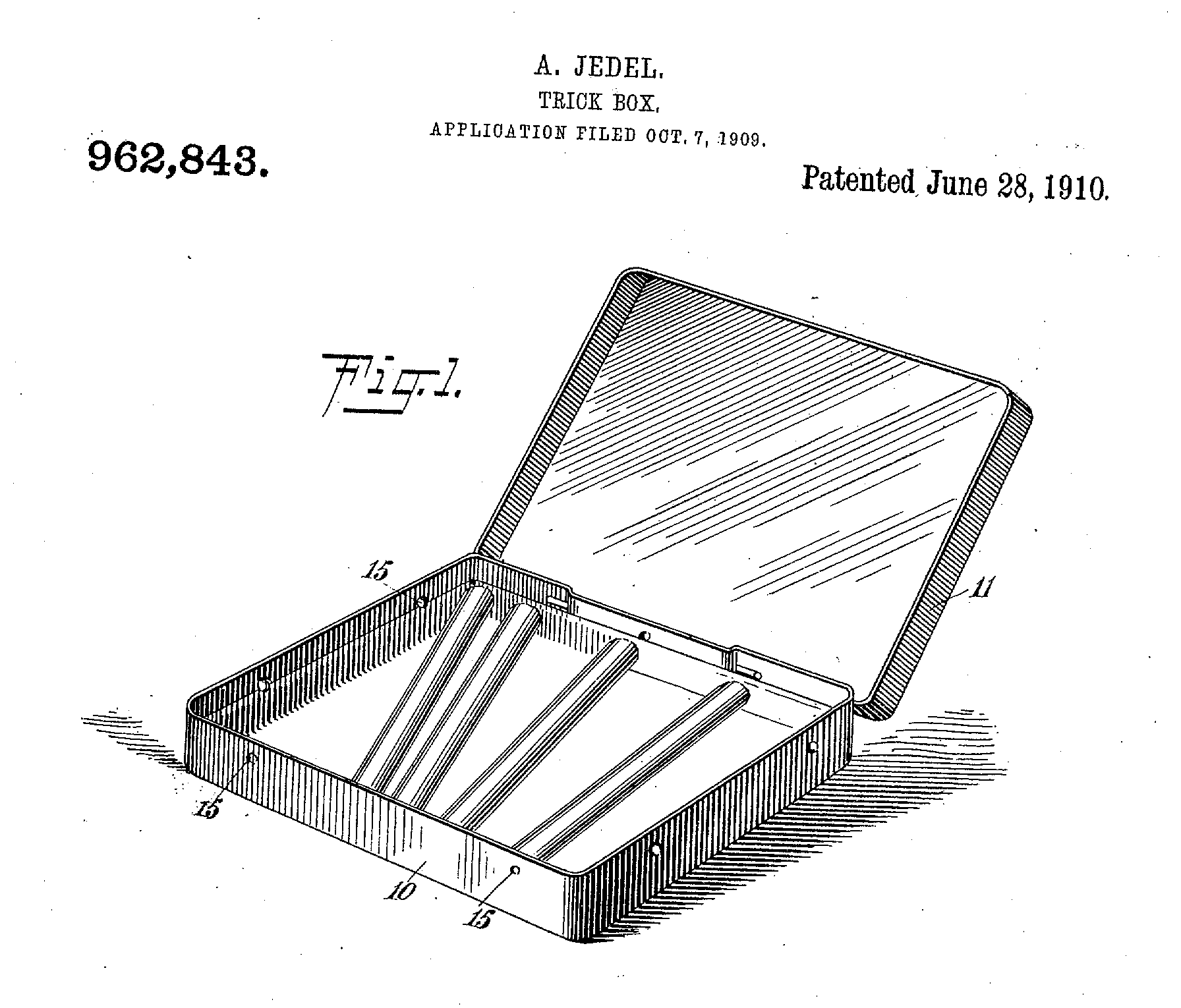
“This invention relates to certain improvements in trick or joke apparatus, the object of the invention being to cover or secure articles within a box in such a manner that the retaining means will normally be invisible.
The invention involves the use of a sheet of colorless transparent glass or other similar material secured within the box and over the articles or contents of the box. When the box is handed to a person and he attempts to remove any of the articles from the box, he will, much to his surprise, find that he cannot grasp the articles because of the intervening glass.”
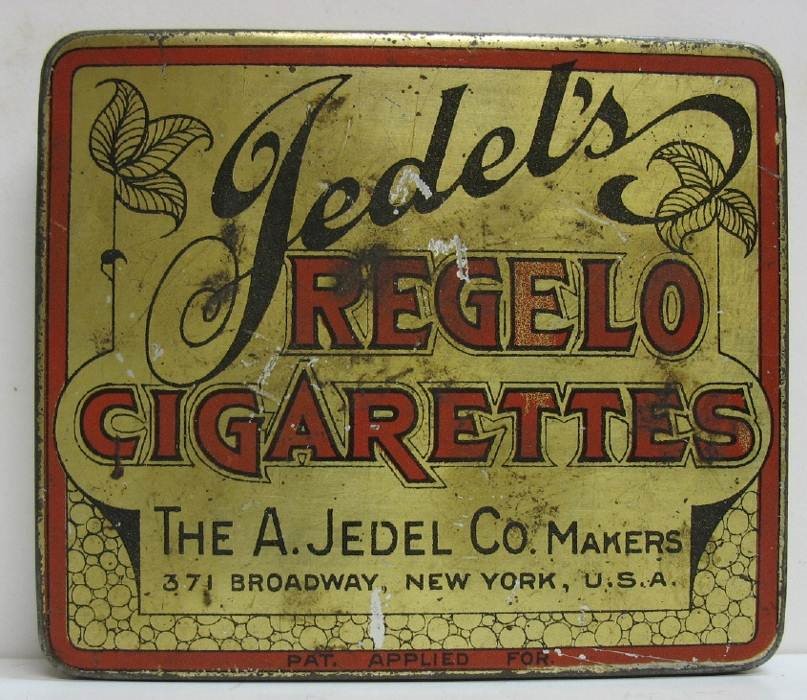
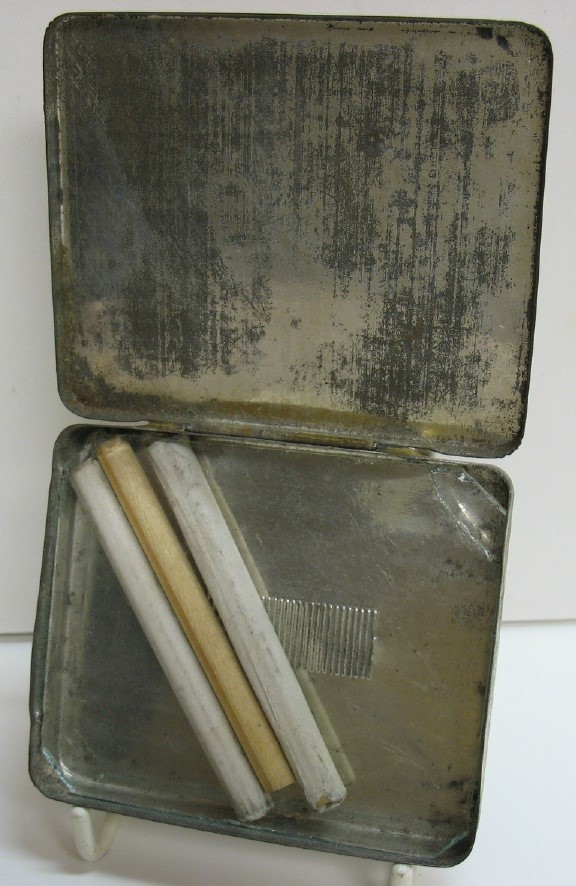
Aaron’s brother Moses was also engaged in an interesting light-related business at this time, and he likely contracted with the Welsbach Company to produce these private label gas mantles for his Newark, New Jersey firm.
“TEN THOUSAND GAS MANTLES, worth from 20c to 35c, To-day at 10c.
One of the largest makers of Gas Mantles [assuming Welsbach…] has sold us his complete overstock and odd lots, representing hundreds of kinds, and bearing a great many labels and brands.
While the Mantles are very similar in character, each store generally has its own labels placed on the boxes. A store may order 50 dozens of a kind, but 53 dozens may come through the work; so the maker has three dozens left on his hands.”
New York Times (display ad) March 1, 1906
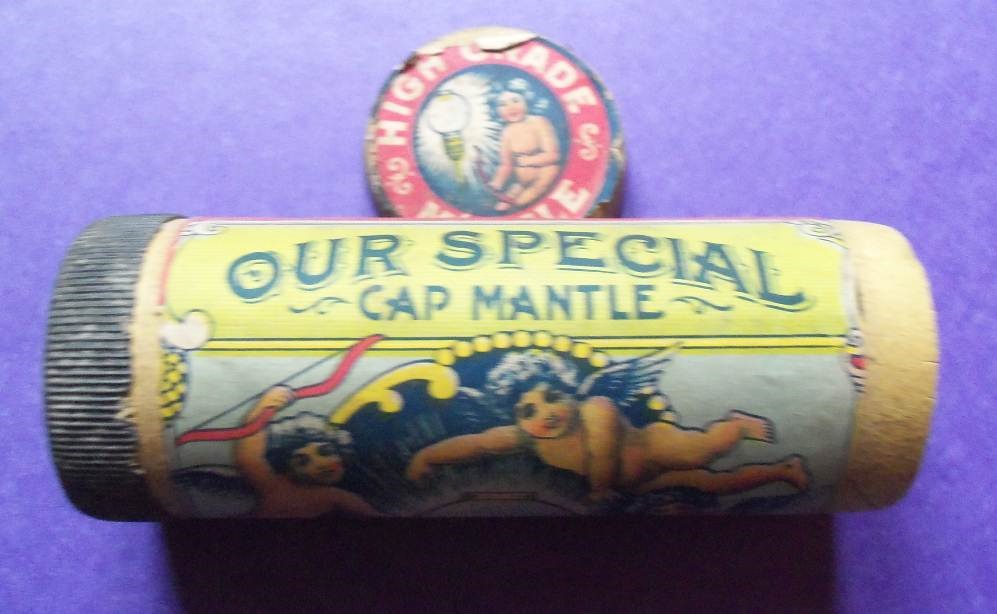
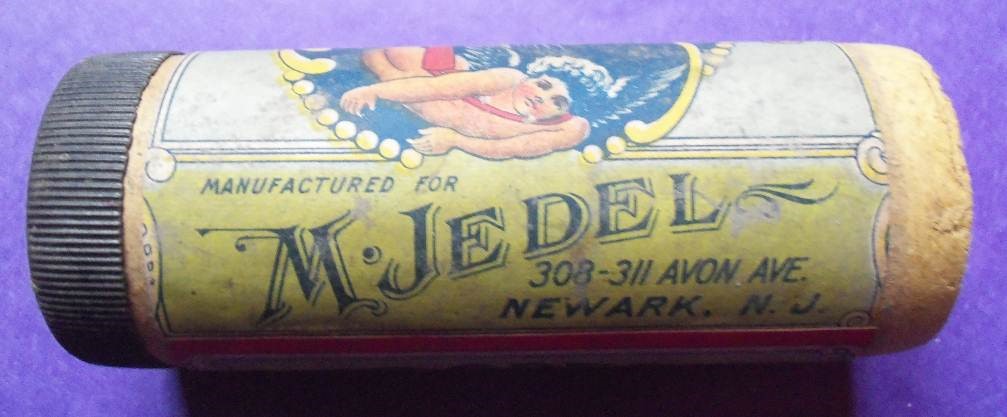
Although the label above clearly says “Manufactured for…,” the 1909 ad below seems to indicate Moses may have been a manufacturer himself at some point.
“GAS MANTLE MANUFACTURER WANTS resident salesmen to cover territory within 100 miles of Buffalo; must be experienced and have good references. M. Jedel, 385 High st., Newark, N.J.”
Buffalo Morning Express, October 20, 1909
One of the products of Jedel’s International Pyrotoy Company was the “Airiowheel”. This was a device he patented on July 15, 1913, re-inventing the sparkler concept to drum up more sales.
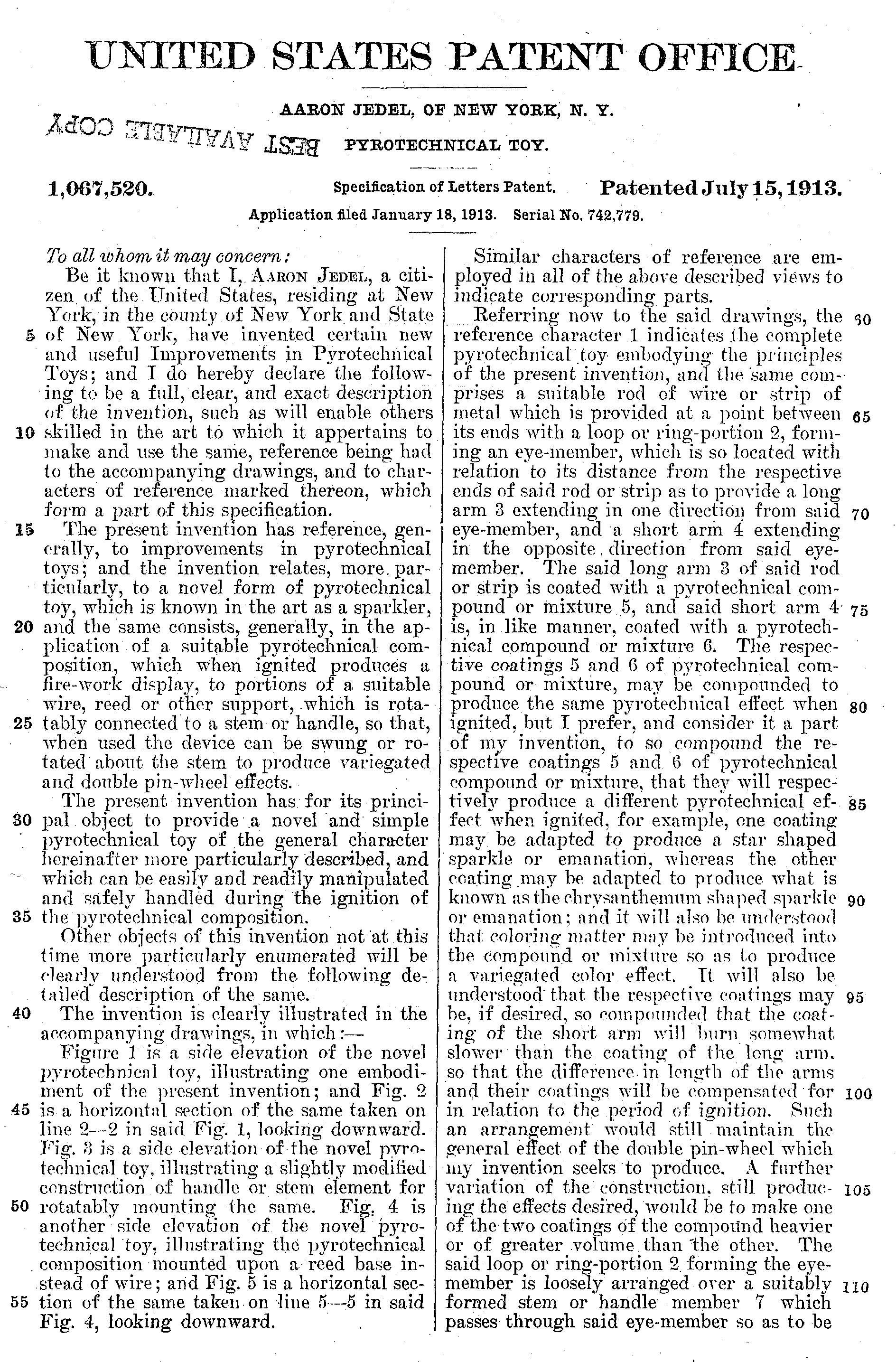
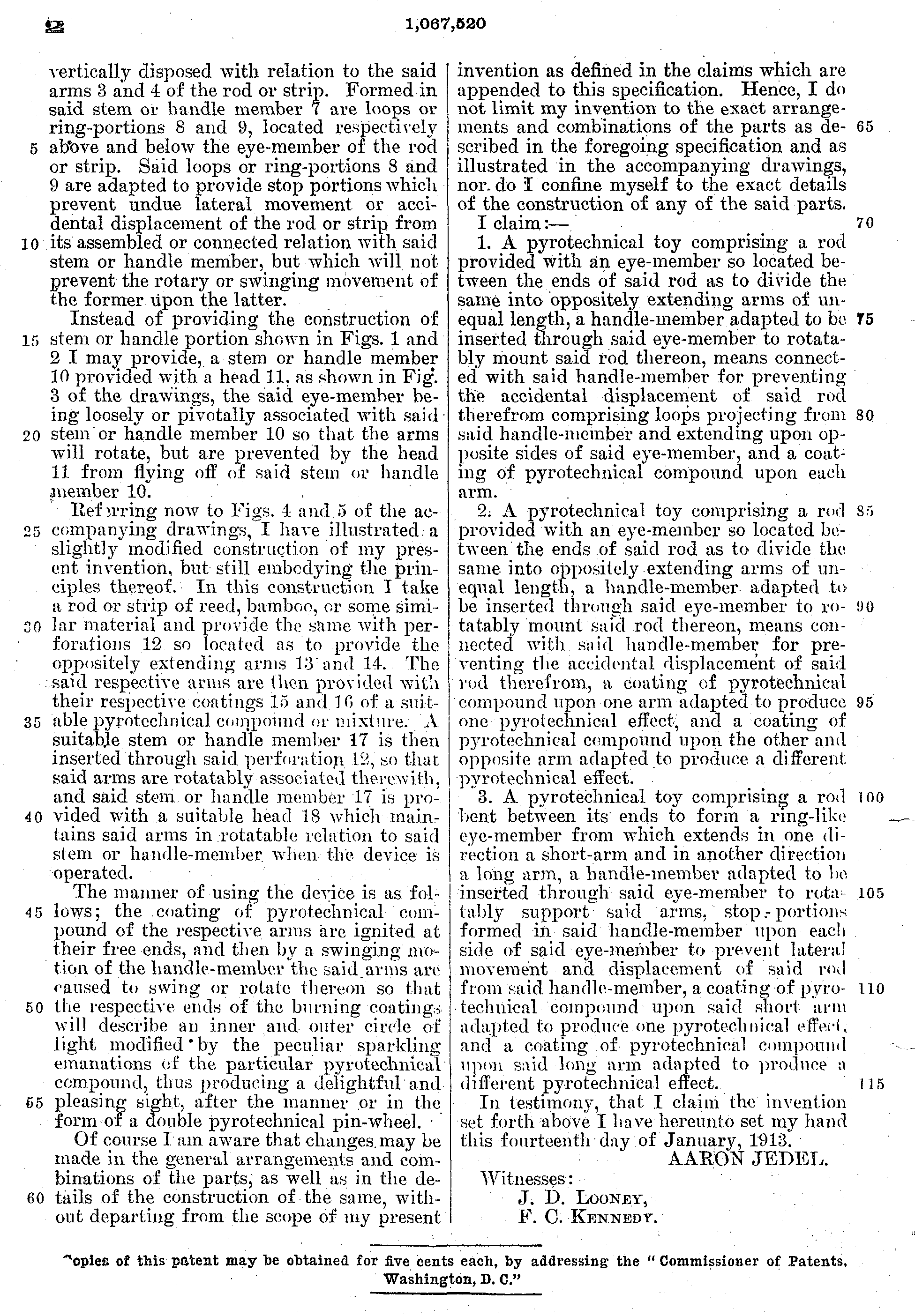
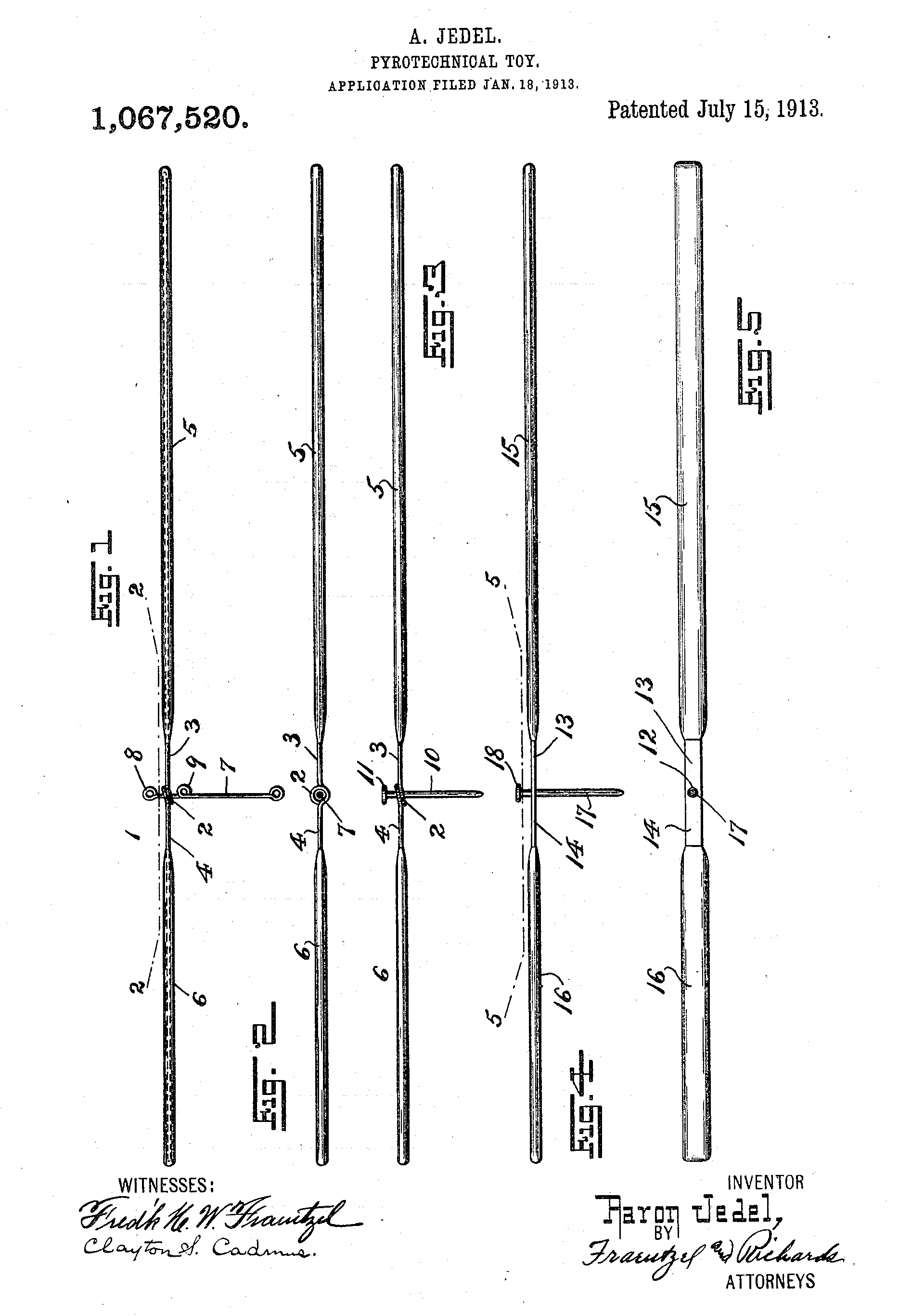




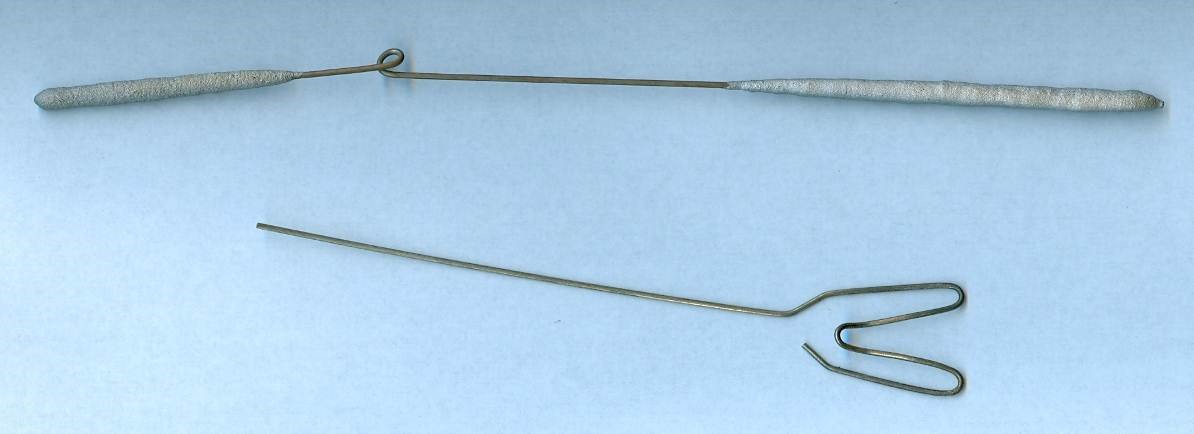
It is interesting to note from the side of the sparkler box that this firm had plants in Berlin, Germany and Newark, Delaware. Perhaps Jedel contracted with another party to make product for foreign markets or owned a stake in a Berlin company.
From the ad below, we can see that Jedel put his product on the market prior to receiving the patent.
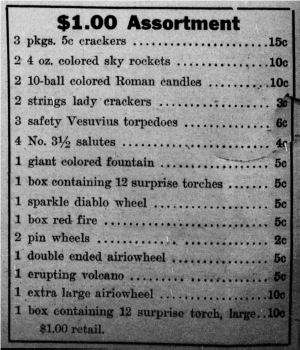
Gift to kids for selling 4 subscriptions to the Tacoma Times, June 26, 1911
His “Airo Wheels” were also to be found in Pennsylvania the month he received the patent.
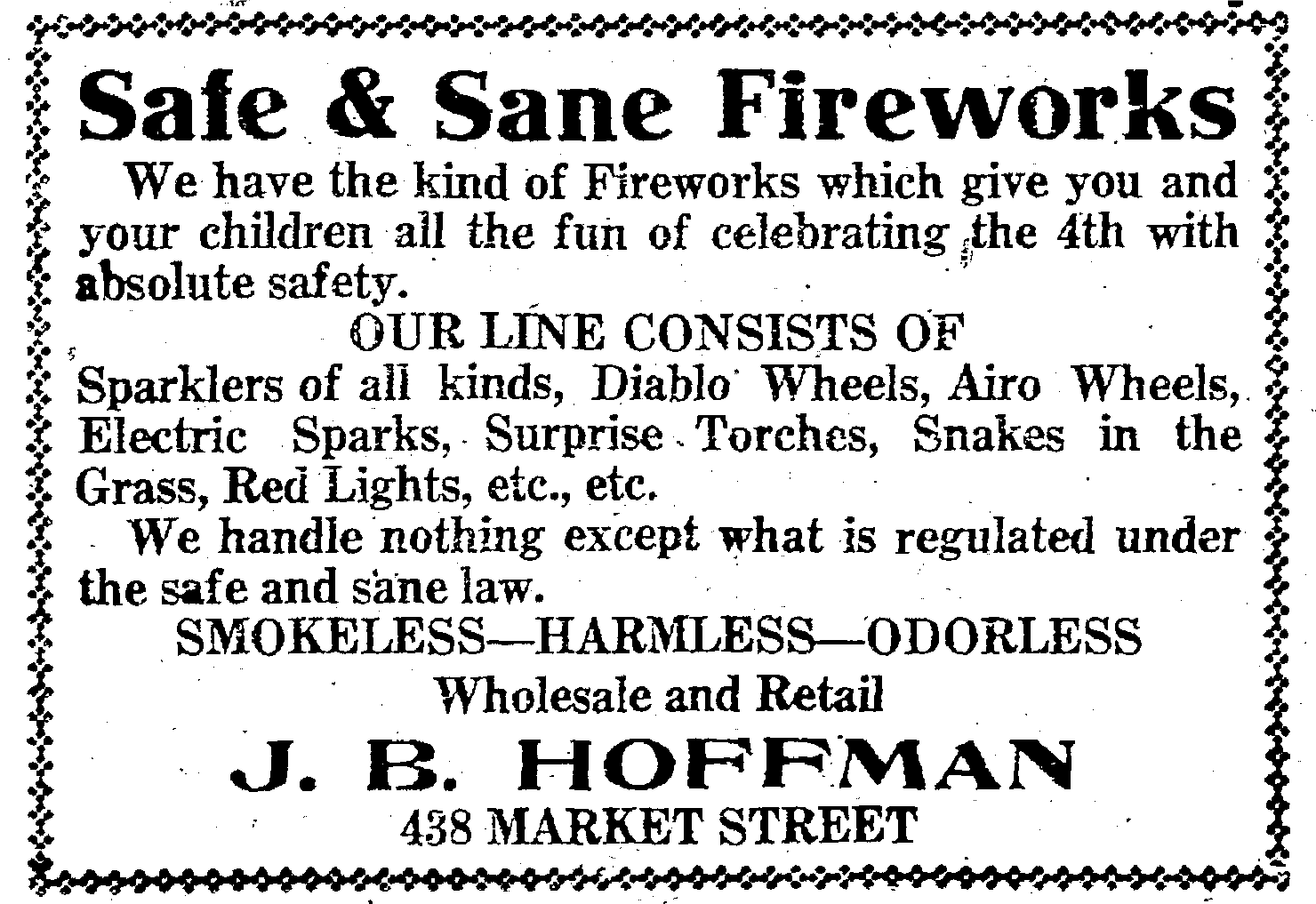
Harrisburg, PA Patriot, July 2, 1913
In 1914 the airiowheel was described in the press. Not only did it have two ends and a spinner, but each end was a different color!
“THE NEWS TRADE – SUMMER GOODS.
With the exodus to the country, seashore and mountains – for some people go early – be sure to regulate your orders and do not let your summer goods run too low. Carry a good line of inexpensive fireworks, for no matter how large an order a family may have had, there is never enough, and the children always want more, and they go to the local store where they may be obtained, at small cost – such as for instance air-wheels [sic] – a fast selling novelty. It is a double end sparkler with loop on center for holder to spin sparkler around. When spinning, one end glows red, the other green and gives as much display as most five-cent articles. It is supplied by news companies.”
The Bookseller, Newsdealer, and Stationer, June 15, 1914
And they were still on the market at the end of World War I, evidently in a variety of colors.
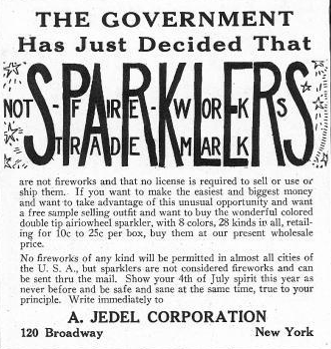
Boys’ Life, July, 1918
Also in 1918 Jedel was actively promoting his “safe and sane” sparkler line through contest notices in Syracuse, New York.
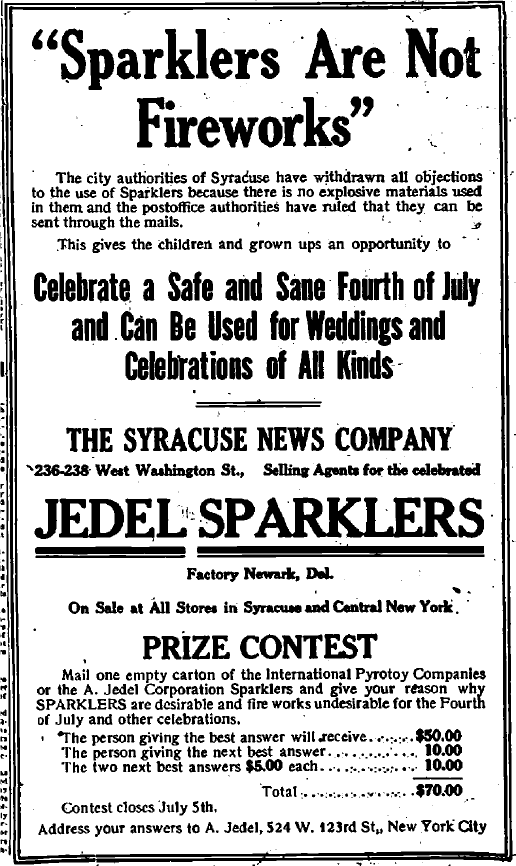
Syracuse [New York] Post Standard, June 30, 1918
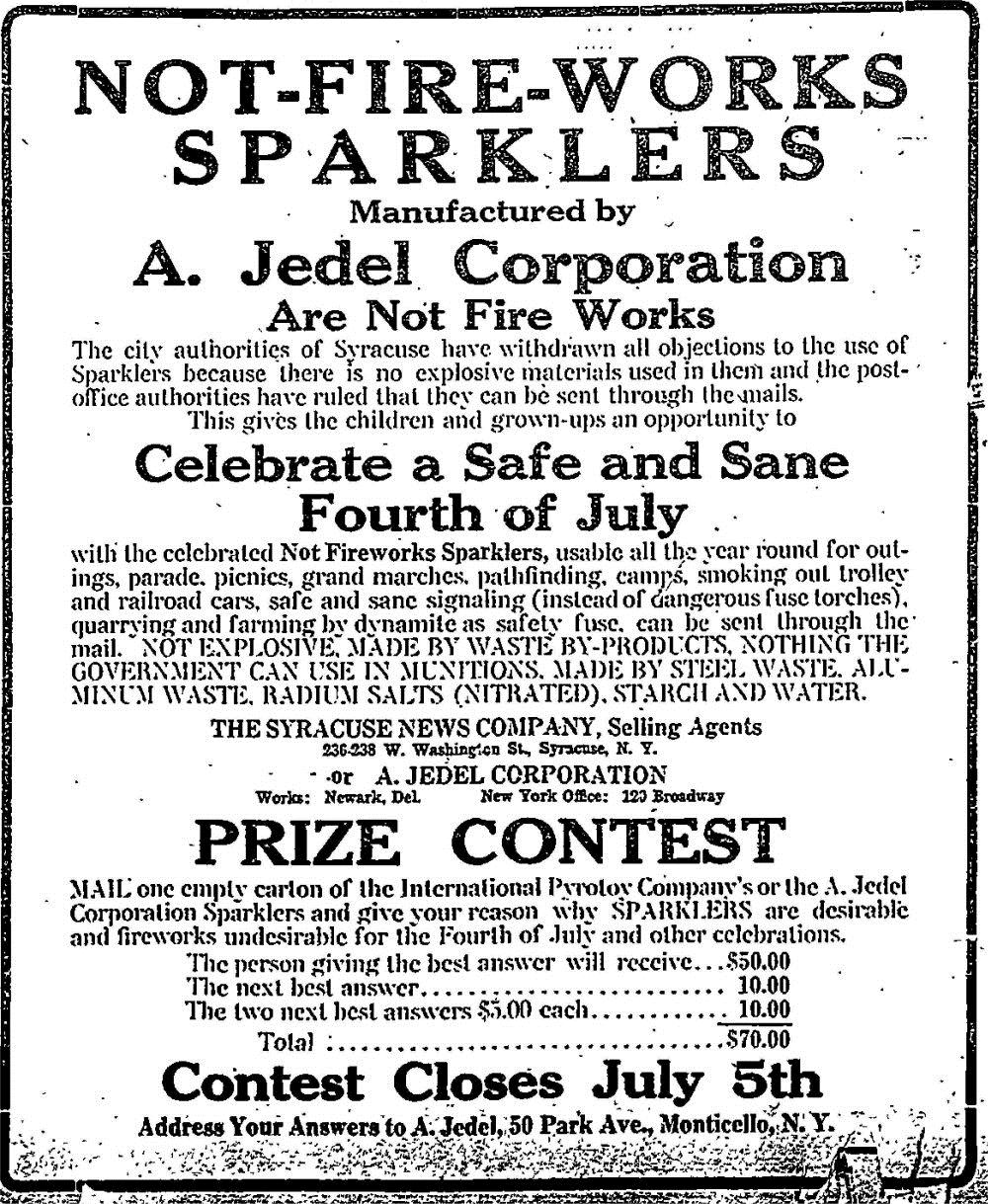
Syracuse [New York] Herald, July 1, 1918
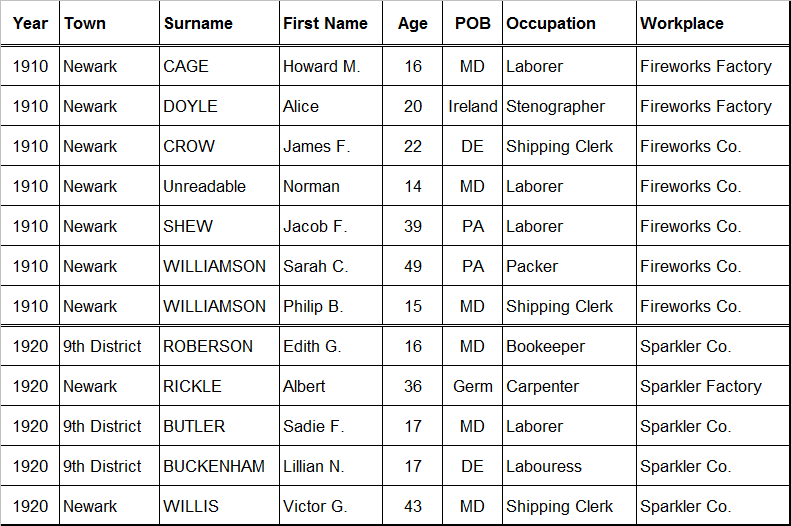
1910 and 1920 US Census data from New Castle County, Delaware showing workers at the Jedel sparkler factory.